Everyday health
T3 (triiodothyronine) blood test in Liverpool
One thyroid hormone, measured on its own.

The T3 (Triiodothyronine) Test is a T3 blood test in Liverpool that measures one thyroid hormone, triiodothyronine, from a single venous sample taken by a clinician at 57 Rodney Street. Your thyroid releases two main hormones, T4 and T3, and T4 is converted into T3. The British Thyroid Foundation describes T3 as the biologically active hormone that regulates your metabolism.
This test is for people who have been asked for a T3 result, or who are following T3 alongside earlier thyroid results. UK guidance usually starts a thyroid check with TSH, adds T4 if TSH is outside the range, and adds T3 when TSH is low. If you want a first look at your thyroid, our Ultimate Specialist Thyroid Screen measures TSH, free T4, free T3 and two thyroid antibodies from one sample.
You do not need a GP referral. The result does not give a diagnosis: your GP reads T3 alongside TSH, T4 and your symptoms, and decides on any care that follows.
What's tested
1 biomarker from a single venous sample.
| Marker | What it tells you |
|---|---|
| Triiodothyronine (T3) | T3, the more active thyroid hormone, mostly made from T4. It is usually read alongside TSH and T4. |
Read more
Who this blood test may suit
A doctor has asked for a T3 result
The British Thyroid Foundation says T3 is usually only used in testing for an overactive thyroid or judging how severe it is. Bring the request with you.
Your TSH was low and you have a T4 result already
NICE suggests that when TSH is below the reference range, free T4 and free T3 are measured in the same sample. The NHS says a low TSH with high T3 and/or T4 usually means an overactive thyroid, so T3 can be the hormone that is raised. This test adds T3 to an earlier result. If that result was a while ago, the full thyroid screen measures all three together in one sample.
You are being followed for an overactive thyroid
During and after some treatments for an overactive thyroid, NICE suggests checking TSH, free T4 and free T3 together until TSH is back within the reference range. If your specialist has asked for a T3 result between appointments, this test provides it. They decide what each result means for your care.
You are keeping track of T3 over time
Dated results let you and your GP see how T3 has moved. The British Thyroid Foundation notes that reference ranges vary between laboratories, so compare each result with the range printed next to it.
What happens at your appointment
- 1
Arrive at 57 Rodney Street for your appointment. No GP referral needed.
- 2
Your clinician confirms the right test for you and answers any questions.
- 3
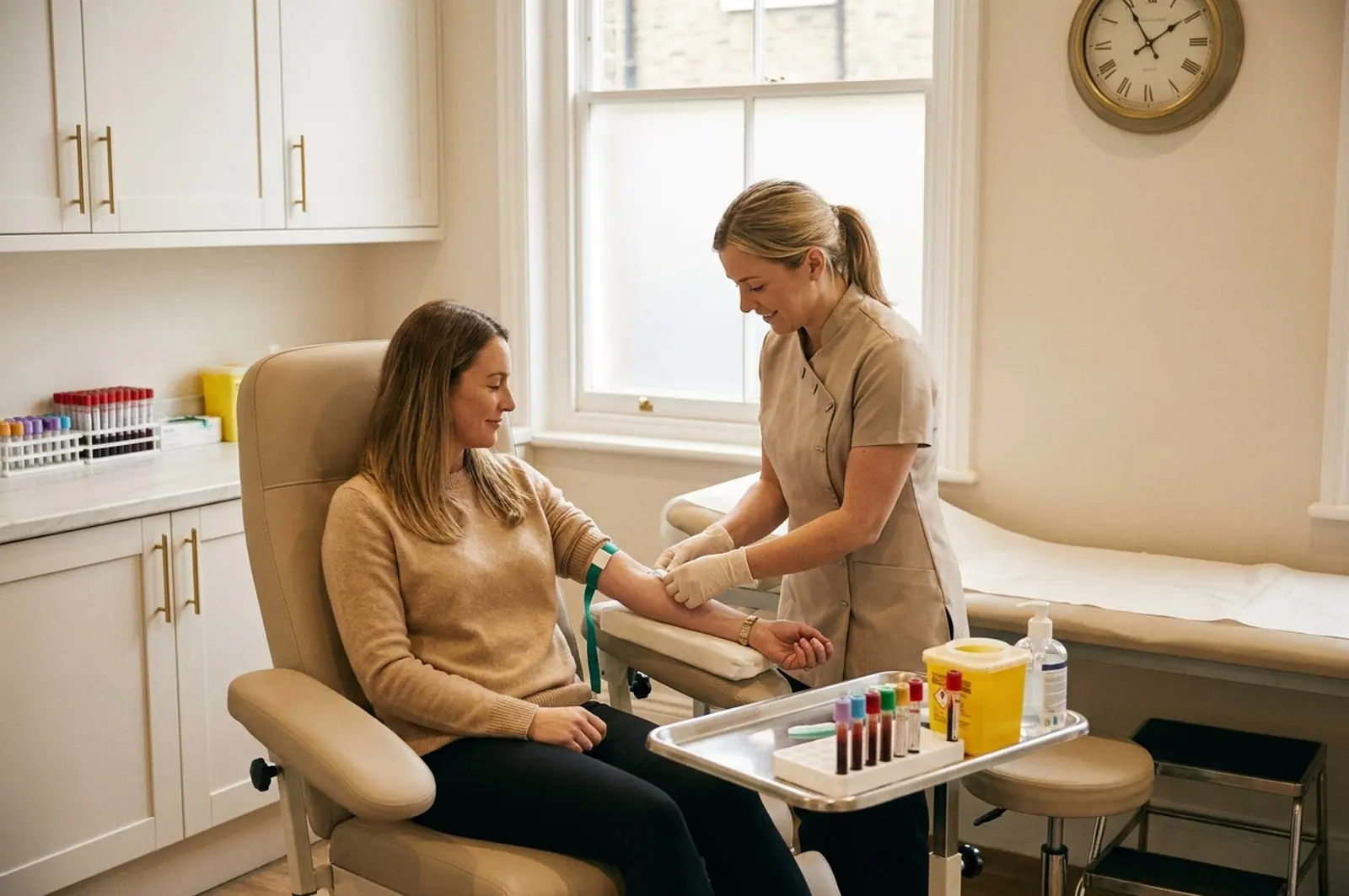
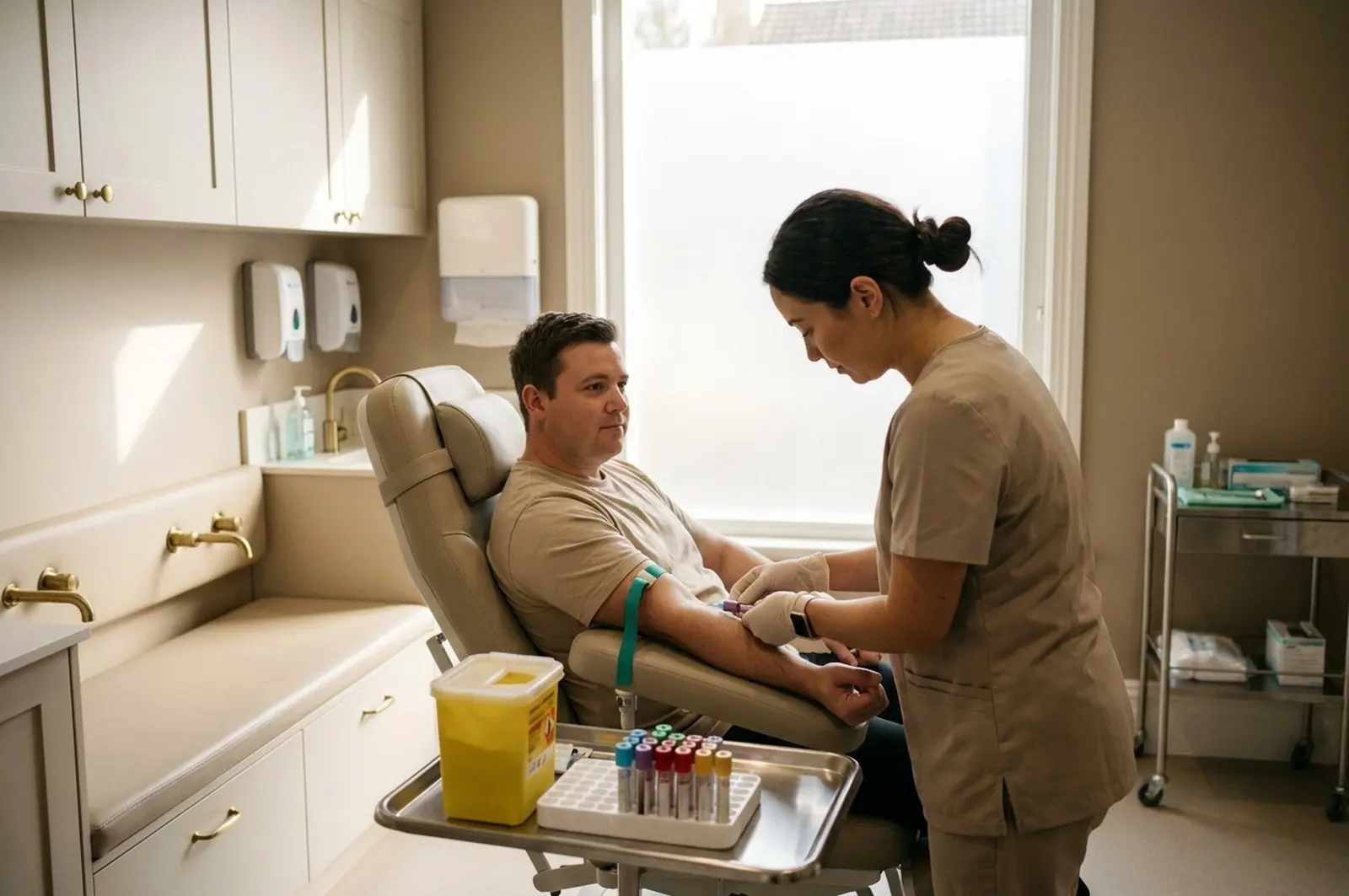
A quick venous blood draw, taken by a clinician.
- 4
Your results are sent to you securely, with clear guidance on any recommended next steps.
How to prepare for your test
- You do not need a GP referral. You can book this test directly online.
- Whether you need to fast depends on the panel. We confirm exactly what to do when your booking is confirmed, and you can call the clinic if you are unsure.
- Tell the clinician about any supplements, especially biotin. NICE says a high intake of biotin from supplements may lead to falsely high or low thyroid results, and the British Thyroid Foundation also asks you to mention supplements that contain iodine.
- Tell us about all your medicines, including any for a thyroid condition, and keep taking them as prescribed. The British Thyroid Foundation lists the contraceptive pill, steroid hormones and several other medicines as things that can affect thyroid results. Changes to a dose should only be made with your own doctor.
- If you are acutely unwell, call us to move your appointment. NICE advises against testing for thyroid problems during an acute illness unless the illness itself may be thyroid related, because the illness can affect the results.
What your results can and cannot tell you
What they can show
- Whether your T3 sits within the laboratory's reference range. Ranges differ between laboratories, so your result is read against the range used for your sample.
- If you already know your TSH is low, T3 adds context. The NHS says a low TSH with high T3 and/or T4 usually points to an overactive thyroid.
- Read with a recent TSH and T4, whether the pattern fits what NICE calls subclinical hyperthyroidism: TSH below the reference range, with free T3 and free T4 still within it.
- A dated T3 result you can add to earlier thyroid tests and share with your GP or specialist.
What they cannot show
- Your TSH and T4 levels. The British Thyroid Foundation says TSH is usually measured first, because if it is normal it is very likely that your thyroid is working normally. This test does not include TSH or T4, and your GP will usually want both before reading a T3 result.
- Whether you have an underactive thyroid. The NHS describes checking TSH and T4 for that, and T3 is not part of the first check.
- The cause of a raised T3. The NHS says that if thyroid hormone levels are high, you may be referred to a specialist for further tests to find the cause, such as a blood test for thyroid antibodies.
- A diagnosis. A result outside the range is a prompt for a conversation with your GP, who reads it with your symptoms and your other results.
When you get your results, and what happens next
Most results are back within 1–3 working days depending on the panel. They are checked by a clinician and sent to you securely, with clear guidance on what to do next, including onward referral where appropriate. If you would like to talk them through, you can add a 30-minute clinician review for £30.
If your T3 falls outside the reference range, we say so plainly and suggest a next step. For T3 that is usually a conversation with your GP. If you do not have recent TSH and T4 results, they will usually want those as well, and they can refer you to a specialist and confirm any diagnosis.
If you are tracking T3 over time, NICE suggests repeating thyroid tests when symptoms get worse or new ones appear, and no sooner than 6 weeks after the most recent test.
Price and booking
The T3 (Triiodothyronine) Test is £75, paid securely online when you book. Appointments are at 57 Rodney Street, Liverpool, Monday to Friday. You can book online, see all test prices, or read how a visit works.
Frequently asked questions
This page is for general information. Blood tests are carried out following a short clinical check to confirm the panel is appropriate for you. Your results are sent to you securely, with clear guidance on any recommended next steps.